 a946c83a07
## Summary

* **What is the goal of this PR?** Fix WiFi file transfer stability
issues (especially crashes during uploads) and improve upload speed via
WebSocket binary protocol. File transfers now don't really crash as
much, if they do it recovers and speed has gone form 50KB/s to 300+KB/s.

* **What changes are included?**
- **WebSocket upload support** - Adds WebSocket binary protocol for file
uploads, achieving faster speeds 335 KB/s vs HTTP multipart)
- **Watchdog stability fixes** - Adds `esp_task_wdt_reset()` calls
throughout upload path to prevent watchdog timeouts during:
    - File creation (FAT allocation can be slow)
    - SD card write operations
    - HTTP header parsing
    - WebSocket chunk processing
- **4KB write buffering** - Batches SD card writes to reduce I/O
overhead
- **WiFi health monitoring** - Detects WiFi disconnection in STA mode
and exits gracefully
- **Improved handleClient loop** - 500 iterations with periodic watchdog
resets and button checks for responsiveness
- **Progress bar improvements** - Fixed jumping/inaccurate progress by
capping local progress at 95% until server confirms completion
- **Exit button responsiveness** - Button now checked inside the
handleClient loop every 64 iterations
- **Reduced exit delays** - Decreased shutdown delays from ~850ms to
~140ms

**Files changed:**
- `platformio.ini` - Added WebSockets library dependency
- `CrossPointWebServer.cpp/h` - WebSocket server, upload buffering,
watchdog resets
- `CrossPointWebServerActivity.cpp` - WiFi monitoring, improved loop,
button handling
- `FilesPage.html` - WebSocket upload JavaScript with HTTP fallback

## Additional Context

- WebSocket uses 4KB chunks with backpressure management to prevent
ESP32 buffer overflow
- Falls back to HTTP automatically if WebSocket connection fails
- The main bottleneck now is SD card write speed (~44% of transfer
time), not WiFi
- STA mode was more prone to crashes than AP mode due to external
network factors; WiFi health monitoring helps detect and handle
disconnections gracefully

---

### AI Usage

Did you use AI tools to help write this code? _**YES**_ Claude did it
ALL, I have no idea what I am doing, but my books transfer fast now.

---------

Co-authored-by: Claude <noreply@anthropic.com>
|
||
|---|---|---|
| .github | ||
| bin | ||
| docs | ||
| include | ||
| lib | ||
| open-x4-sdk@bd4e670750 | ||
| scripts | ||
| src | ||
| test | ||
| .clang-format | ||
| .clangd | ||
| .gitignore | ||
| .gitmodules | ||
| LICENSE | ||
| partitions.csv | ||
| platformio.ini | ||
| README.md | ||
| USER_GUIDE.md | ||
CrossPoint Reader
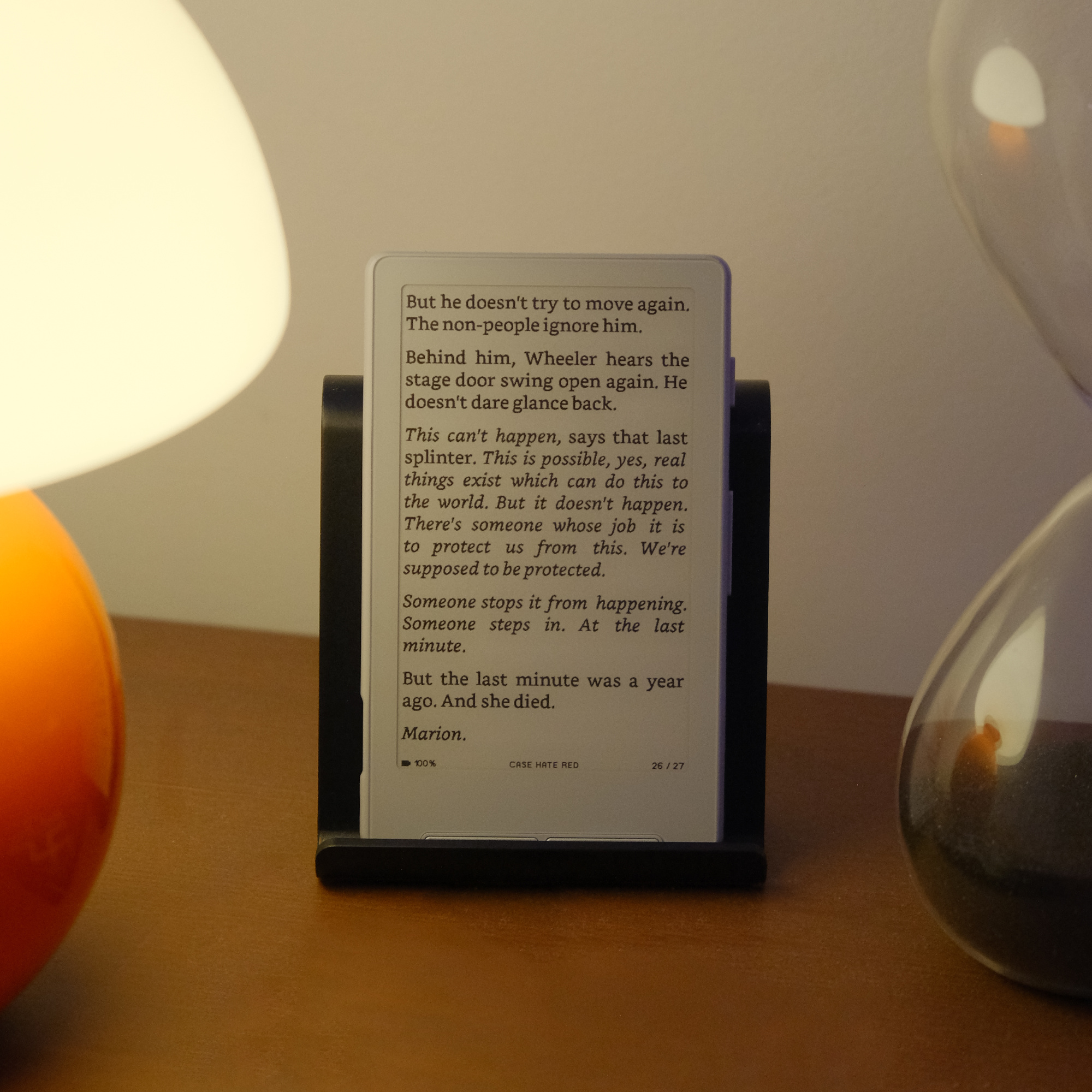
Firmware for the Xteink X4 e-paper display reader (unaffiliated with Xteink). Built using PlatformIO and targeting the ESP32-C3 microcontroller.
CrossPoint Reader is a purpose-built firmware designed to be a drop-in, fully open-source replacement for the official Xteink firmware. It aims to match or improve upon the standard EPUB reading experience.
Motivation
E-paper devices are fantastic for reading, but most commercially available readers are closed systems with limited customisation. The Xteink X4 is an affordable, e-paper device, however the official firmware remains closed. CrossPoint exists partly as a fun side-project and partly to open up the ecosystem and truely unlock the device's potential.
CrossPoint Reader aims to:
- Provide a fully open-source alternative to the official firmware.
- Offer a document reader capable of handling EPUB content on constrained hardware.
- Support customisable font, layout, and display options.
- Run purely on the Xteink X4 hardware.
This project is not affiliated with Xteink; it's built as a community project.
Features & Usage
- EPUB parsing and rendering (EPUB 2 and EPUB 3)
- Image support within EPUB
- Saved reading position
- File explorer with file picker
- Basic EPUB picker from root directory
- Support nested folders
- EPUB picker with cover art
- Custom sleep screen
- Cover sleep screen
- Wifi book upload
- Wifi OTA updates
- Configurable font, layout, and display options
- User provided fonts
- Full UTF support
- Screen rotation
See the user guide for instructions on operating CrossPoint.
Installing
Web (latest firmware)
- Connect your Xteink X4 to your computer via USB-C
- Go to https://xteink.dve.al/ and click "Flash CrossPoint firmware"
To revert back to the official firmware, you can flash the latest official firmware from https://xteink.dve.al/, or swap back to the other partition using the "Swap boot partition" button here https://xteink.dve.al/debug.
Web (specific firmware version)
- Connect your Xteink X4 to your computer via USB-C
- Download the
firmware.binfile from the release of your choice via the releases page - Go to https://xteink.dve.al/ and flash the firmware file using the "OTA fast flash controls" section
To revert back to the official firmware, you can flash the latest official firmware from https://xteink.dve.al/, or swap back to the other partition using the "Swap boot partition" button here https://xteink.dve.al/debug.
Manual
See Development below.
Development
Prerequisites
- PlatformIO Core (
pio) or VS Code + PlatformIO IDE - Python 3.8+
- USB-C cable for flashing the ESP32-C3
- Xteink X4
Checking out the code
CrossPoint uses PlatformIO for building and flashing the firmware. To get started, clone the repository:
git clone --recursive https://github.com/daveallie/crosspoint-reader

# Or, if you've already cloned without --recursive:
git submodule update --init --recursive
Flashing your device
Connect your Xteink X4 to your computer via USB-C and run the following command.
pio run --target upload
Internals
CrossPoint Reader is pretty aggressive about caching data down to the SD card to minimise RAM usage. The ESP32-C3 only has ~380KB of usable RAM, so we have to be careful. A lot of the decisions made in the design of the firmware were based on this constraint.
Data caching
The first time chapters of a book are loaded, they are cached to the SD card. Subsequent loads are served from the
cache. This cache directory exists at .crosspoint on the SD card. The structure is as follows:
.crosspoint/
├── epub_12471232/       # Each EPUB is cached to a subdirectory named `epub_<hash>`
│   ├── progress.bin     # Stores reading progress (chapter, page, etc.)
│   ├── cover.bmp        # Book cover image (once generated)
│   ├── book.bin         # Book metadata (title, author, spine, table of contents, etc.)
│   └── sections/        # All chapter data is stored in the sections subdirectory
│       ├── 0.bin        # Chapter data (screen count, all text layout info, etc.)
│       ├── 1.bin        #     files are named by their index in the spine
│       └── ...
│
└── epub_189013891/
Deleting the .crosspoint directory will clear the entire cache.
Due the way it's currently implemented, the cache is not automatically cleared when a book is deleted and moving a book file will use a new cache directory, resetting the reading progress.
For more details on the internal file structures, see the file formats document.
Contributing
Contributions are very welcome!
If you're looking for a way to help out, take a look at the ideas discussion board. If there's something there you'd like to work on, leave a comment so that we can avoid duplicated effort.
To submit a contribution:
- Fork the repo
- Create a branch (
feature/dithering-improvement) - Make changes
- Submit a PR
CrossPoint Reader is not affiliated with Xteink or any manufacturer of the X4 hardware.
Huge shoutout to diy-esp32-epub-reader by atomic14, which was a project I took a lot of inspiration from as I was making CrossPoint.